

Share


Have you ever sent a proposal to a client only to be met with silence? Or worse, the dreaded “Thanks, we’ll think about it”?
Often, the problem isn’t your price, and it isn’t the quality of your services. The problem is how you presented the choice. Most sales professionals make the same mistake: they send one single option.
From a neuro-sales perspective, this is a dead end. Today, we’ll explore why your client’s brain effectively needs three options to make a decision and how you can technically implement this using Proposaly.
The Binary Choice Trap
When you send a proposal with a single price tag (e.g., “Web Development — $3,000”), you force the client’s brain into a binary trap: “Buy” or “Don’t Buy.”
In this situation, the brain starts looking for danger. This activates the “Reptile Brain”—the survival system responsible for instinctive decisions. Its main job is to avoid risk. Spending money is a risk. Without context to compare your price against, the client instinctively goes to compare you with your competitors.
Why Does the Brain Need Exactly 3 Options?
According to neuro-sales principles, the mind specifically needs three options before making a decision. This isn’t just a marketing trick; it is biological:
-
Sense of Control: Providing choices shifts the internal question from “Should I spend money?” to “Which of these options fits me best?”
-
Brain Chemistry: Showing three scenarios generates a chemical process in the brain that provokes a positive emotion, which stimulates decision-making.
-
Safety: Three scenarios (e.g., Economy, Standard, Premium) create a sense of safety by covering different needs and fears.
As the core tenet of neuro-sales states: “We don’t sell to people; we sell to the mind”.
The “Goldilocks” Strategy: Crafting the Perfect Trio
To make this work, your three tiers should perform specific psychological functions:
-
Option 1: The Anchor (High Price). Its job is not necessarily to be sold, but to make the middle option look like a bargain. It establishes high value.
-
Option 2: The Target (Middle Price). This is what you actually want to sell. Against the “Anchor,” it looks like the rational, safe choice.
-
Option 3: The Safety Net (Low Price). A stripped-down version for those with strict budget fears. It prevents the client from walking away entirely.
How to Implement This in Proposaly Without the Chaos
If you try to send three different PDF files or one long text document describing three complex packages, you risk overwhelming the client’s cognitive load. Complexity kills sales.
This is exactly where Proposaly comes in.
Based on this research, we’ve designed the selection of the package that’s the best designed for choosing one of three options. Our interface allows you to create interactive pricing tables directly inside your proposal, ensuring the “one of three” logic is presented clearly and effectively.
-
The client sees three columns side-by-side (just like the SaaS pricing pages they are used to).
-
They can hover, compare features, and select their preferred tier with a single click.
-
The total price updates automatically.
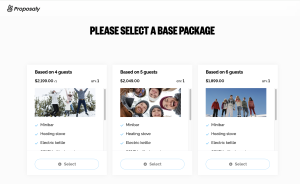
👉 Take a look at this proposal to see the “Power of 3” in action.
Conclusion
Stop forcing your clients to choose between “Yes” and “No.” Give them the choice of “A, B, or C.” Use a scientific approach to sales to reduce client stress and increase your average deal size.
Create your first 3-tier proposal in Proposaly today and watch how your conversion rate changes.
✌️ Work less. Win more. From sending to signing – in one flow with Proposaly.io

Don't forget to share this article!
PPC Marketing Expert?
Get things done with Adcore Marketing Cloud.
5 essential PPC tools under one roof.

 Back to top