
Stay ahead of the game

Sign up for our newsletter to receive the latest digital marketing strategies and insights for the month ahead, delivered straight to your inbox!

    Get updates. Stay ahead. Win more.

    The Ultimate Business Proposal Structure: A Template That Converts
    InspirationSales

    Staring at a blank page is the hardest part of sales. You have had the meeting, the client is interested, and now you hear the dreaded phrase: “Send me a proposal.” Most people rush to Google, look for a “business proposal template,” and end up downloading a rigid, ugly PDF that looks exactly like everyone else’s.

    But your clients don’t want to read a 20-page document. They want a clear, concise roadmap that explains exactly how you will solve their problem.

    In this guide, we are going to give you a field-tested proposal structure (including copy-paste text scripts) that covers everything you need to close the deal. And the best part: you don’t need a PDF to use it.

    Why the “Standard” PDF Template is Failing You

    Before we look at the text, let’s talk about delivery. Traditional formats like Word and PDF often work against you:

    • They are unreadable on mobile: 40% of proposals are opened on phones. Pinching and zooming a PDF is a terrible user experience.

    • No analytics: You hit “send” and pray, with no way of knowing if they opened it, skipped to the pricing, or forwarded it to their boss.

    • Friction: To sign it, the client often has to print, sign, scan, and email it back.

    The structure below works best when used in a web-based proposal tool (like Proposaly), where the client can read it like a website and sign with one click.

    The 6-Step Winning Proposal Structure

    Whether you are an agency, a consultant, or a SaaS company, every winning proposal follows this psychological flow: Context – Problem – Solution – Timeline – Investment – Next Steps.

    Here is the exact text template you can adapt for your next deal.

    1. The Executive Summary (The “Hook”)

    Don’t start with your company history. Start with them.

    What to write:

    “Thank you for the opportunity to discuss [Project Name]. Based on our conversation on [Date], it is clear that [Company Name] is looking to [Main Goal, e.g., increase organic traffic / launch a new app] to achieve [Business Objective, e.g., 20% year-over-year growth]. This proposal outlines how we will help you bridge that gap.”

    2. The Problem Statement

    Prove you listened. If you don’t get this right, the rest doesn’t matter.

    What to write:

    “Currently, [Company Name] is facing challenges with [Specific Pain Point 1] and [Specific Pain Point 2]. This is resulting in [Negative Consequence, e.g., wasted ad spend / lost productivity]. Without a strategic shift, these issues may continue to impact your bottom line.”

    3. The Solution (The “Deliverables”)

    Be specific but result-oriented. Don’t just list tasks; list outcomes.

    What to write:

    “To solve these challenges, we propose a comprehensive strategy focused on:”

    • Phase 1: Diagnosis & Strategy: We will audit your current [System/Process] to identify low-hanging fruit.

    • Phase 2: Execution: Our team will implement [Specific Service] to drive immediate results.

    • Phase 3: Optimization: Ongoing monitoring to ensure we hit the [Key Metric] target.

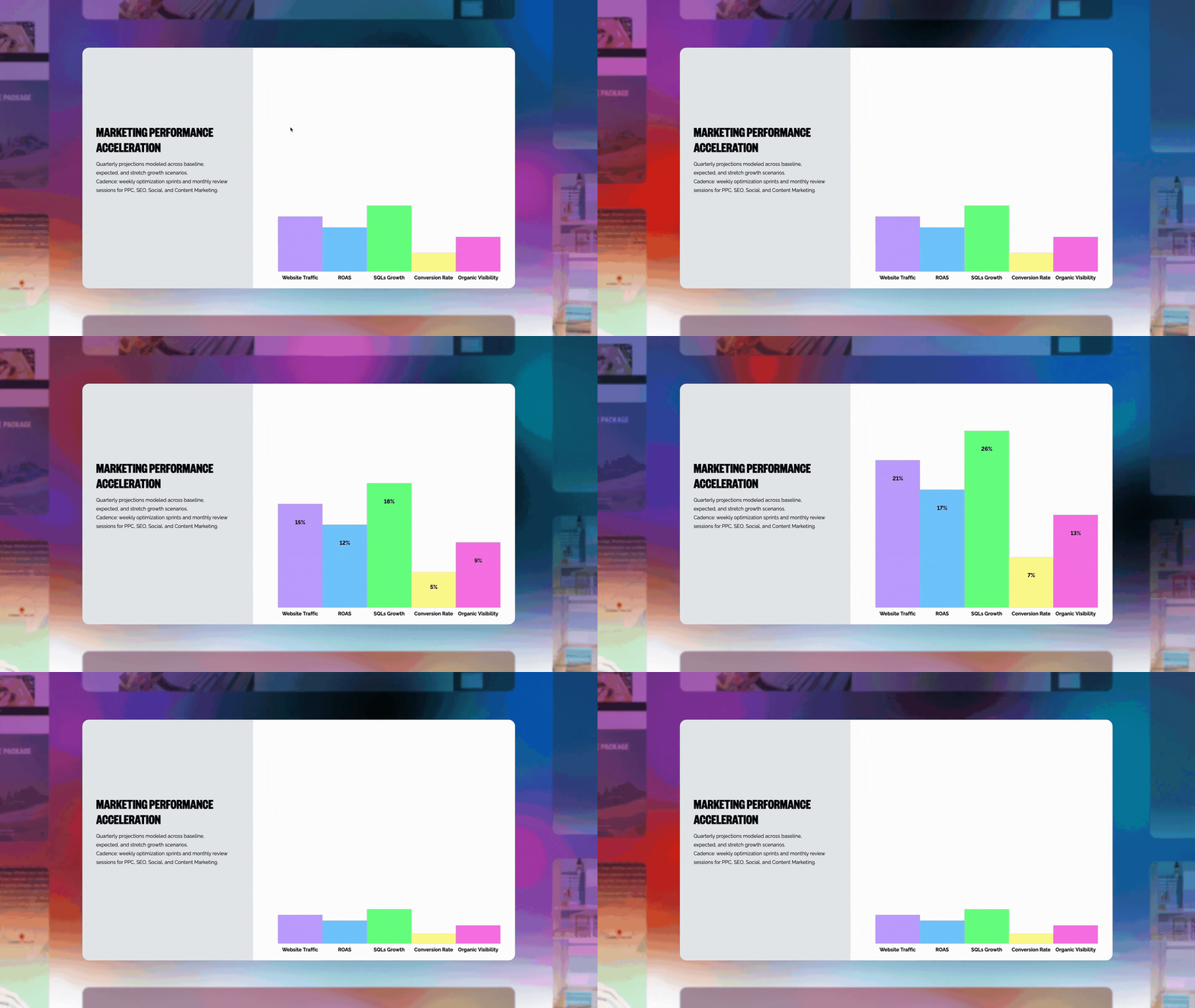
    💡 Pro Tip: In a tool like Proposaly, you can include images, interactive graphs and videos here to visually demonstrate your work, rather than just describing it in text.

    Proposaly interactive bar chart feature displaying marketing KPIs

    4. The Timeline

    Set expectations immediately to avoid scope creep later.

    What to write:

    “We are ready to kick off immediately upon signature. Here is our estimated roadmap:”

    • Weeks 1–2: Onboarding and initial research.

    • Weeks 3–6: Development and first draft review.

    • Week 8: Final launch and handover.

    5. The Investment (Pricing)

    This is where the “Neurosales” psychology comes in. Never give just one price. Give options.

    When you offer a single price, the decision is “Yes vs. No.” When you offer three packages, the decision becomes “Which one?”

    Structure it like this:

    • Option A (Essential): The bare minimum to get the job done. ($X)

    • Option B (Recommended): The standard package that includes everything they asked for. ($Y)

    • Option C (Growth): The “all-in” package with extra speed or VIP support. ($Z)

    “Please select the package that best fits your current goals. Note that you can upgrade your package at any time.”

    6. The Call to Action (CTA)

    Don’t make them work to hire you.

    Bad CTA: “Let me know what you think.” Good CTA: “To get started, simply select your preferred package above and sign below. Once signed, we will schedule our kickoff call for next Tuesday.”

    Moving Beyond the Document

    You could copy the text above into a Word document. It would be better than 90% of the proposals out there.

    But imagine if that proposal could sell for you.

    With Proposaly, you can take this structure and turn it into an interactive, web-based experience.

    • Interactive Pricing: Your client can click “Option B” and see the total update automatically (no calculator needed).

    • Embedded Media: Show your portfolio, don’t just tell them about it.

    • Instant Sign-off: Legally binding e-signatures built right in.

    Stop sending static files that get lost in the inbox. Start sending proposals that close deals.

    ✌️ Work less. Win more. Start building your proposal with Proposaly.io

    Share this article
    Back to top